


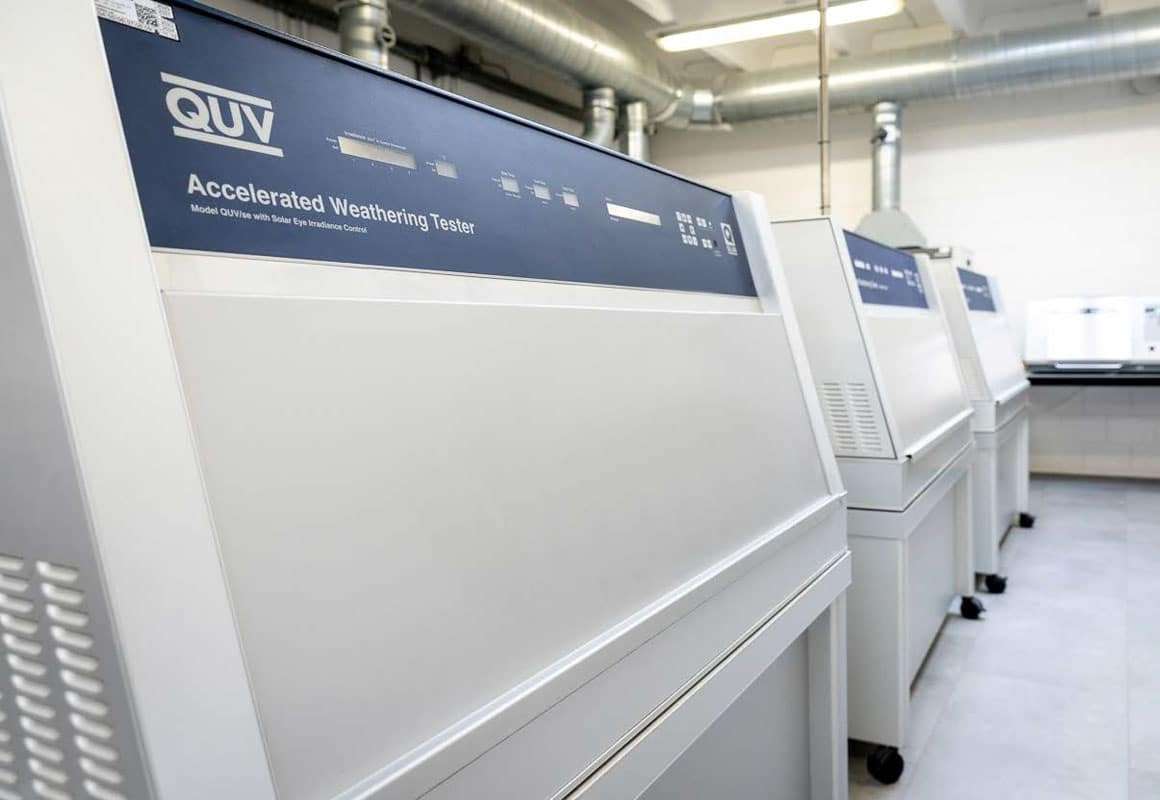
Accelerated weathering tests: how do they work and what do you gain from them?
In the Test explained series we look at one test at a time: why you would do it, how it works and what you can do with the result. This time: accelerated weathering tests. How well does your product stand up to sunlight?
Why do we carry out this test?
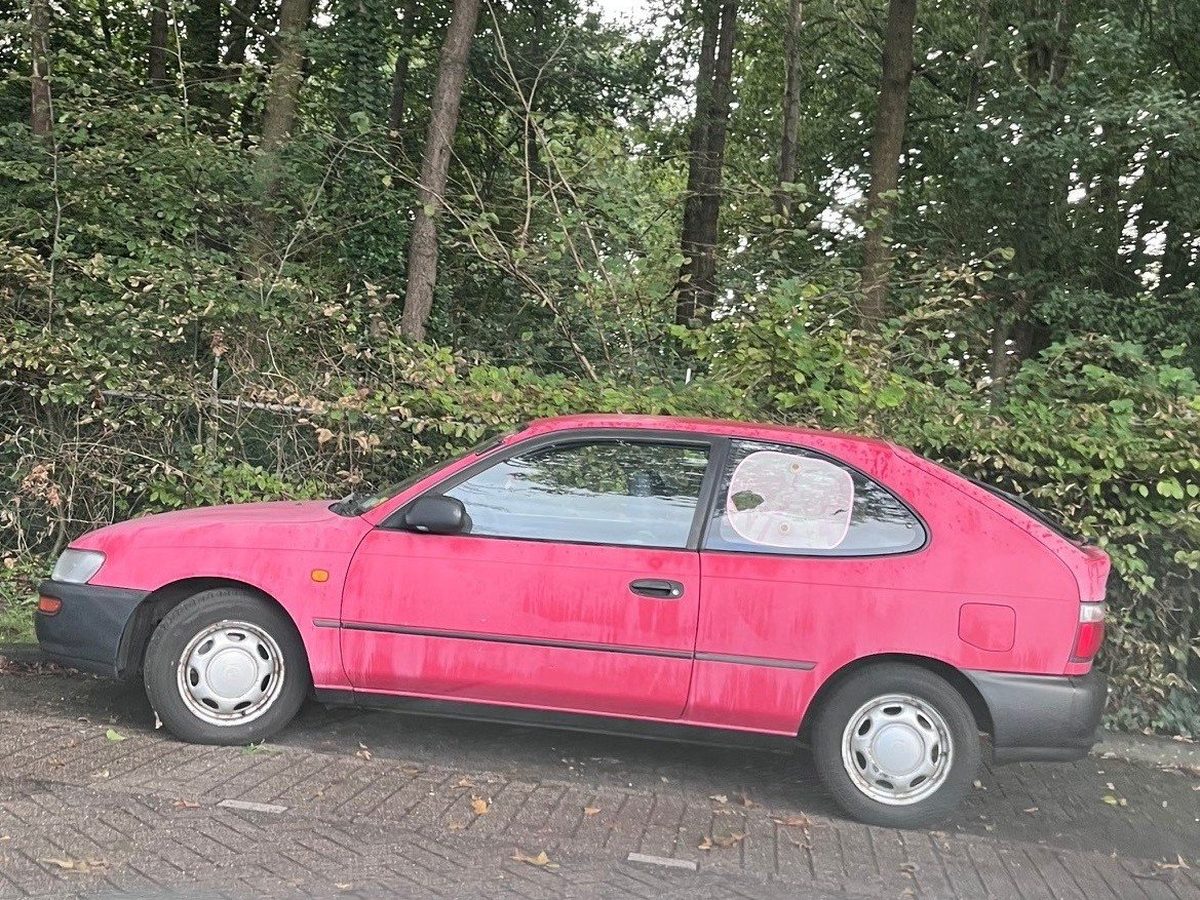
Coatings and plastics that are exposed to sunlight in use will degrade over time. We call this weathering. How quickly weathering occurs depends on the quality of the material. But how long does it take before your product starts to discolour or show other changes?
We test this with two weathering tests: the Xenon Arc test and the QUV test.
What can you do with the result?
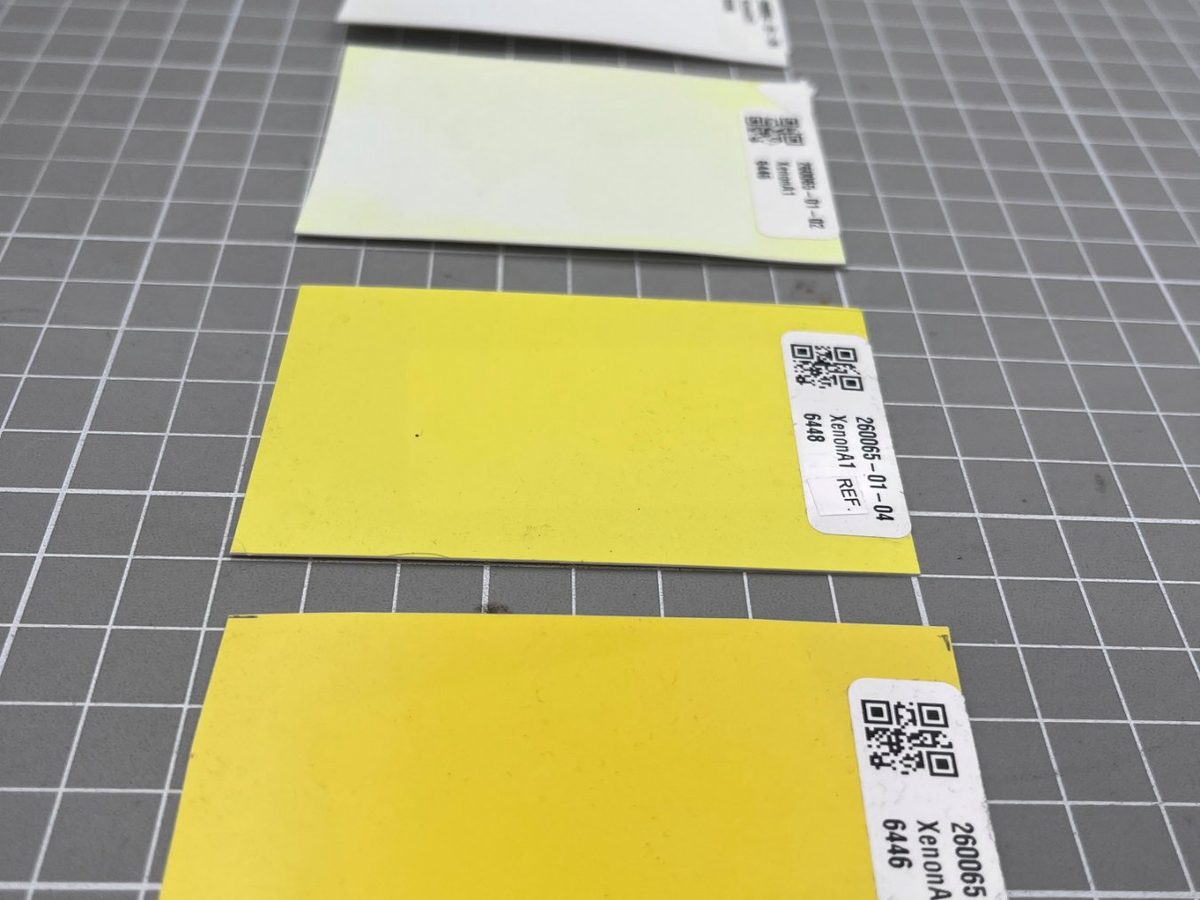
The result helps you estimate weathering resistance and colour retention over the longer term. This allows you to make the right choices in design and surface treatment.
Please note: what this test does not tell you
- No fixed conversion factor. There is no fixed factor for converting test duration into years of use.
- Not just colour. Weathering sometimes causes not only colour difference but also mechanical damage.
Which standards do we use?
A standard is an internationally agreed method. For coatings, ISO 16474 is usually used; for plastics, ISO 4892. There are also standards that are applied less often, such as ASTM G154, ASTM G155 and NEN-EN-IEC 60068-2-5, as well as various company-specific standards.
- Xenon Arc test on coatings. ISO 16474-2 describes how the xenon test must be carried out and sets requirements for the maintenance and calibration of the equipment.
- QUV test on coatings. ISO 16474-3 describes how the QUV test must be carried out and sets requirements for the maintenance and calibration of the equipment.
- Xenon Arc test on plastics. ISO 4892-2 describes how the xenon test must be carried out and sets requirements for the maintenance and calibration of the equipment.
- QUV test on plastics. ISO 4892-3 describes how the QUV test must be carried out and sets requirements for the maintenance and calibration of the equipment.
These standards describe how exposure must take place, not how the assessment must be done. Nor do they say how long the test must last or which acceptance criteria apply: that depends on the use and the expected service life. We are happy to advise you on this.
How do we carry out the test?
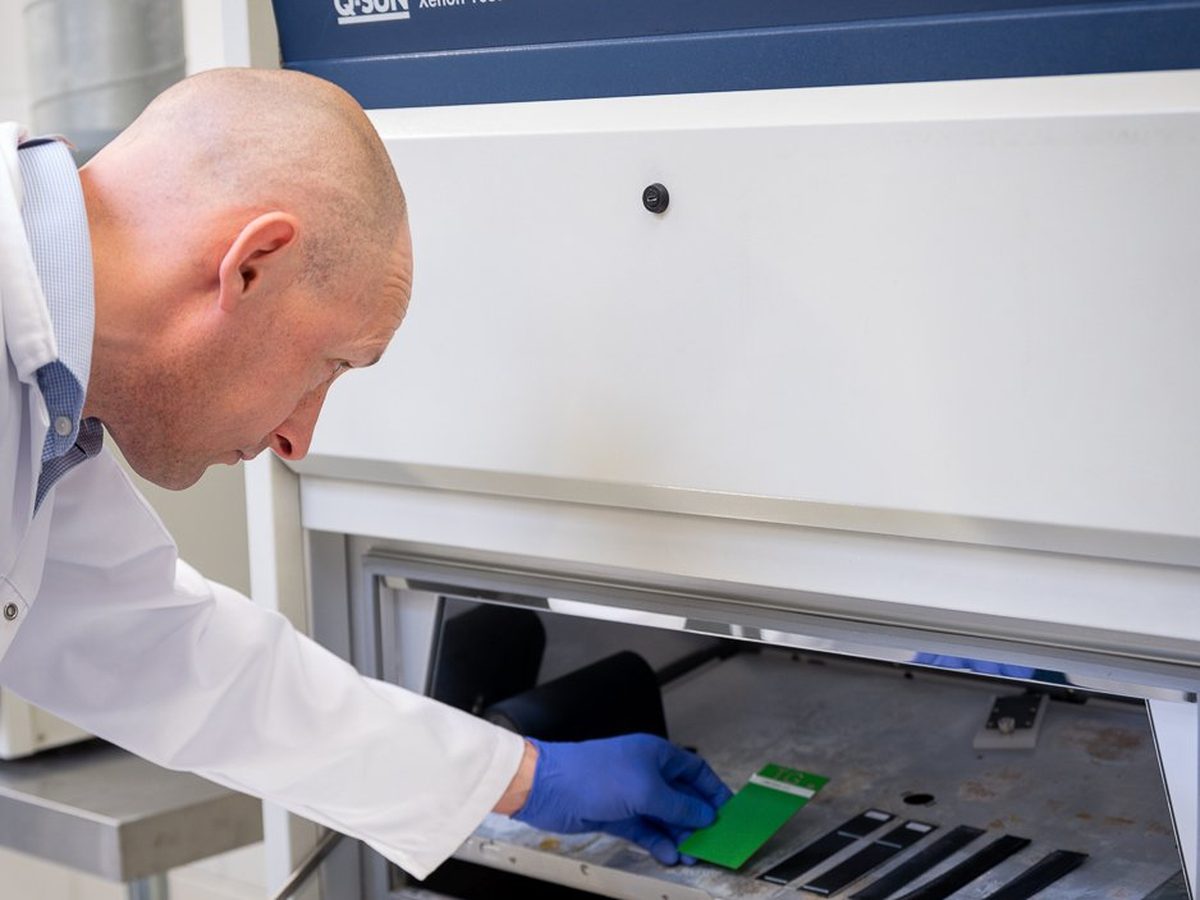
Test samples are exposed in a test chamber to a cycle of light and, where applicable, moisture for a pre-agreed period. Afterwards, we assess which changes have occurred.
Test conditions: light, periodic exposure to moisture, and heat.
- 1. Sample preparation. The samples to be tested are labelled and, if necessary, mounted in a holder.
- 2. Exposure. The samples are exposed to the test environment for the pre-agreed duration. In the QUV test this is usually 8 hours of light and 4 hours of water condensation (simulating dew). In the xenon test it is 102 minutes of light without moisture, alternating with 18 minutes of light combined with water spray (simulating rain).
- 3. Assessment. At the end of the test, the samples are carefully rinsed with water, after which they can be assessed.
The most common mistakes with this test
It may seem simple: put the test panels in the cabinet and let it run. Yet things often go wrong due to a lack of knowledge and experience.
- Wrong test duration or exposure method. When determining the test duration and test conditions, the expected service life and the location (UV index) must be taken into account. Is the product outdoors all day in practice, or only for part of its service life (think of a bicycle or a lawnmower)? Wrong choices are often made here, leading to incorrect conclusions. How we do it: we calculate the right test duration based on specialist knowledge and experience.
- Using unsuitable water. In the xenon test, the dry-wet cycle can leave salts and silicates behind. If the water used is not sufficiently free of contamination, this causes stains that can lead to a false-negative result when colour and gloss are assessed. How we do it: at M2LAB we use ultrapure demineralised water, as the standard prescribes. This prevents staining.
- No proper acceptance criteria. Carrying out a test without acceptance criteria is pointless. It is important to define clearly which requirements the coating must meet once the test is complete. How we do it: depending on the substrate and the application, we formulate matching performance requirements.
How do we assess the result?
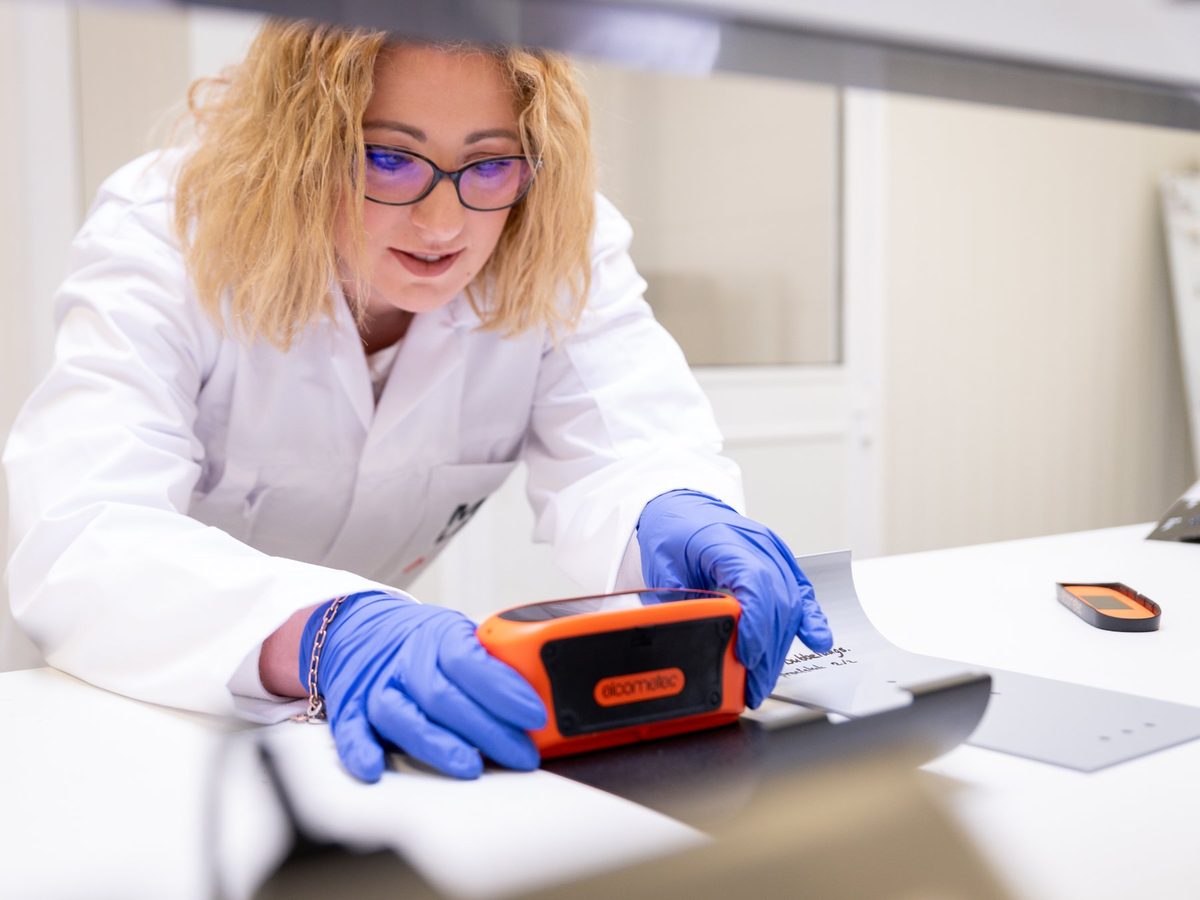
What we look at: there is almost always a visual assessment, in which we record where deviations occur and after how long.
How: a visual assessment can simply be described in words, but it can also be formally quantified using standards. For colour difference, ISO 105-A02 is a widely used standard, in which the colour difference is classified using a grey scale. In addition, we can measure colour and gloss with specialised equipment. This makes the degree of change in appearance truly measurable.
Criteria: as with the test duration, we agree with the client beforehand which requirements must be met once the test is complete. This is often based on company-specific standards or reference samples.
How do we know the test is right?
The conditions in the chamber must be the same every time, and the assessment must be carried out in the same way, even by different lab technicians. That is why we monitor the following.
- Irradiance calibration. The chamber continuously measures and adjusts the light intensity using UV sensors. These sensors are calibrated every 500 hours against an ISO 17025-traceable reference sensor.
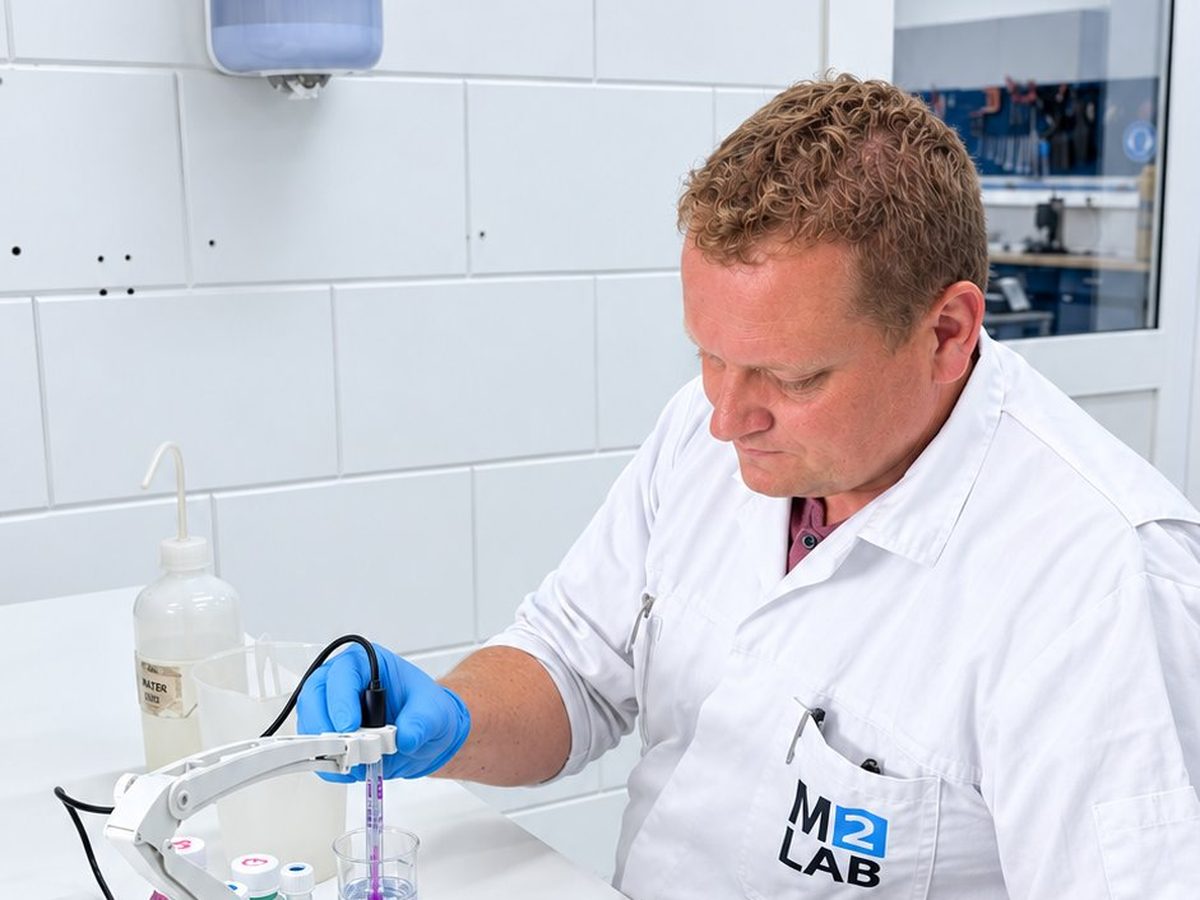
- Demineralised water check. The quality of the ultrapure demineralised water is checked weekly.
- Temperature. The chamber temperature is controlled and logged automatically, so that we can trace how the exposure went if needed.
Quality you can demonstrate
M2LAB is accredited to ISO/IEC 17025. What does that mean? An independent body, in the Netherlands the Dutch Accreditation Council (Raad voor Accreditatie, RvA), has established that we carry out our tests competently, impartially and repeatably. It is not a one-off stamp: the RvA returns regularly to reassess it.
The most important evidence: round robin testing
In a round robin (interlaboratory comparison), several laboratories receive the same material and carry out the same test. The results are then compared. If our result deviates, we find out why and adjust our working method. This demonstrates that our results match those of other labs.
What else we do
- Calibration. We regularly compare our measuring equipment against ISO 17025-traceable references.
- Fixed method. Every test follows a defined, proven method in accordance with the standard.
- Qualified people. Only demonstrably trained staff carry out tests and assessments.
- Measurement uncertainty. We know how accurate our result is and take that into account.
- Audits. We carry out internal audits. We investigate errors and complaints down to the root cause.
For you, this means: a test report you can build on, even if a discussion arises later.
Would you like to know how well your product stands up to weathering?
We test to the standard that suits your application, and explain the result clearly.
M2LAB investigates the service life of coated products: corrosion, sunlight, chemicals, mechanical stress and visual appearance.


