


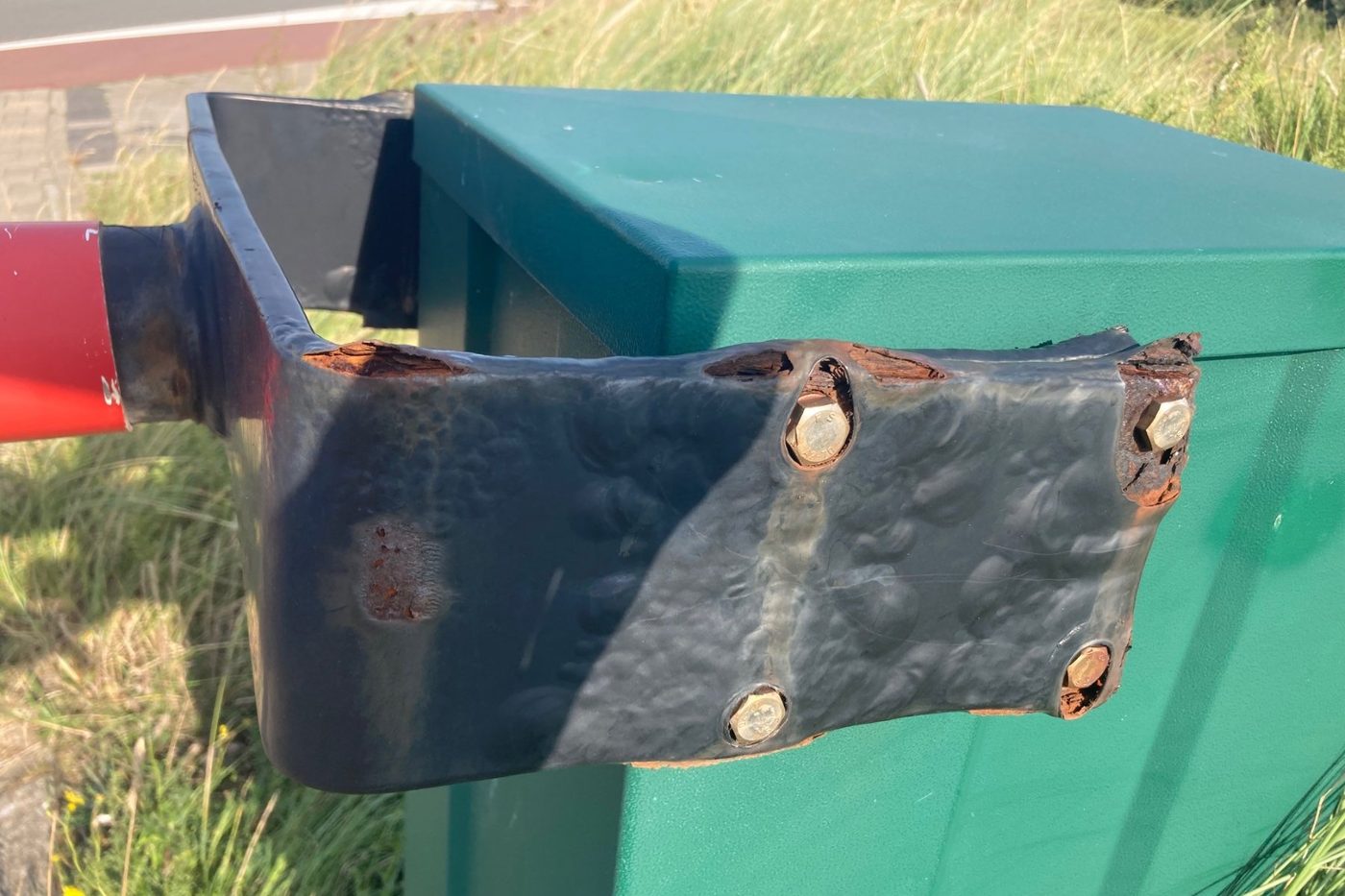
Unsightly, but above all dangerous
Would the owner be happy with this? That is the question we ask ourselves about every product we come across. In this series we put the coating of a wide range of products, objects and structures under the microscope. This time: a boom barrier in IJmuiden, and how a single poorly treated component can cause an entire structure to fail.
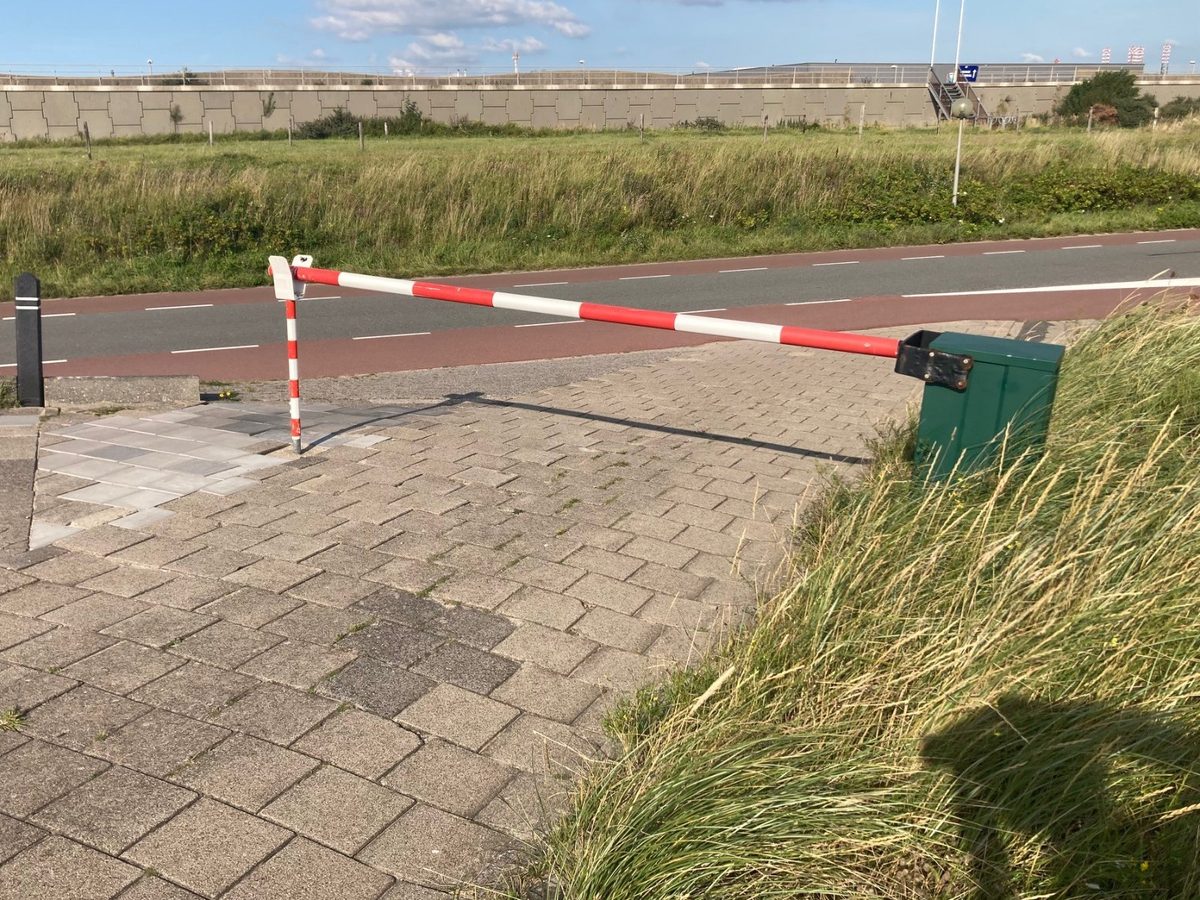
From a distance: nothing much wrong
This barrier stands right by the sea in IJmuiden, just about the most corrosive environment we know of in the Netherlands. If you pull up to it in your car, it looks fine, apart from some brown staining.
On closer inspection: two very different components
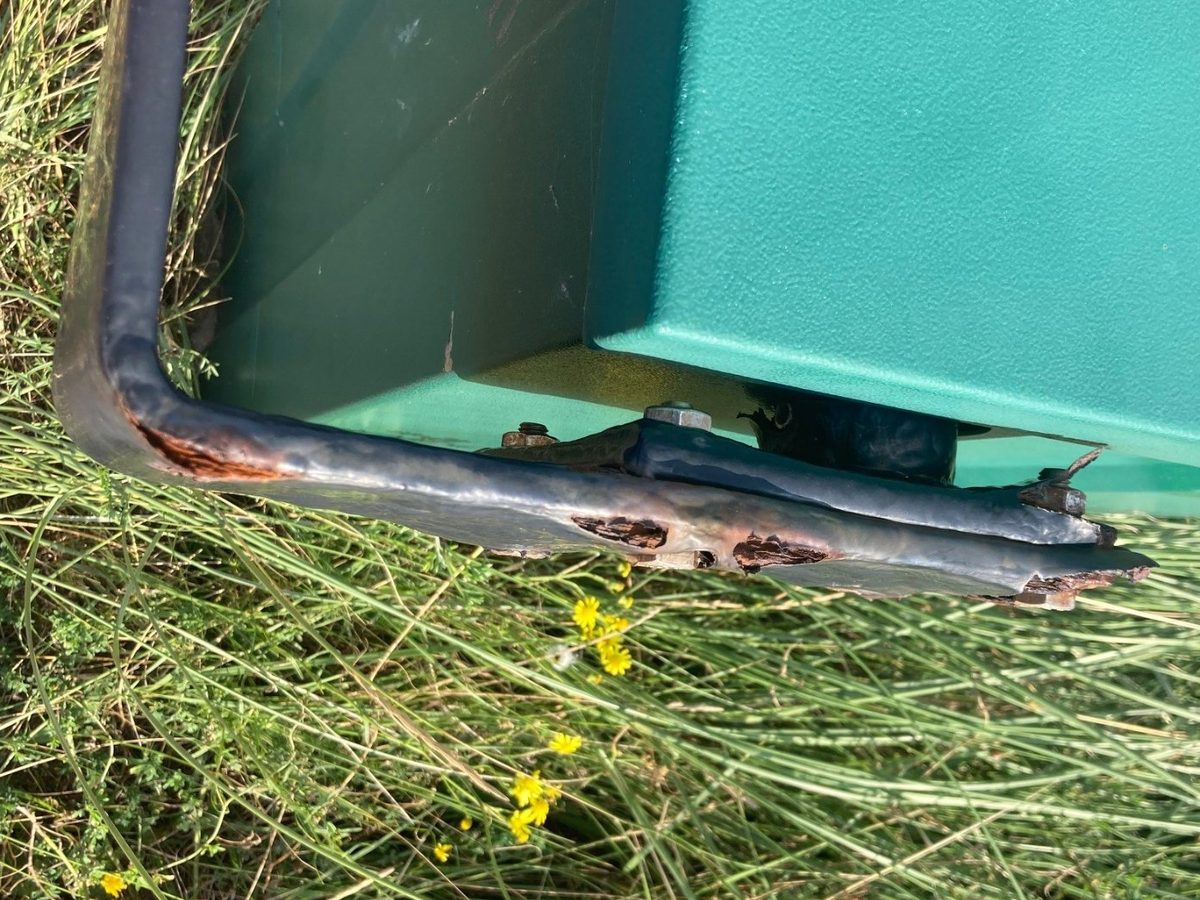
Up close we see two things. The boom itself and the housing are unaffected, but the black bracket between them has rusted through completely.
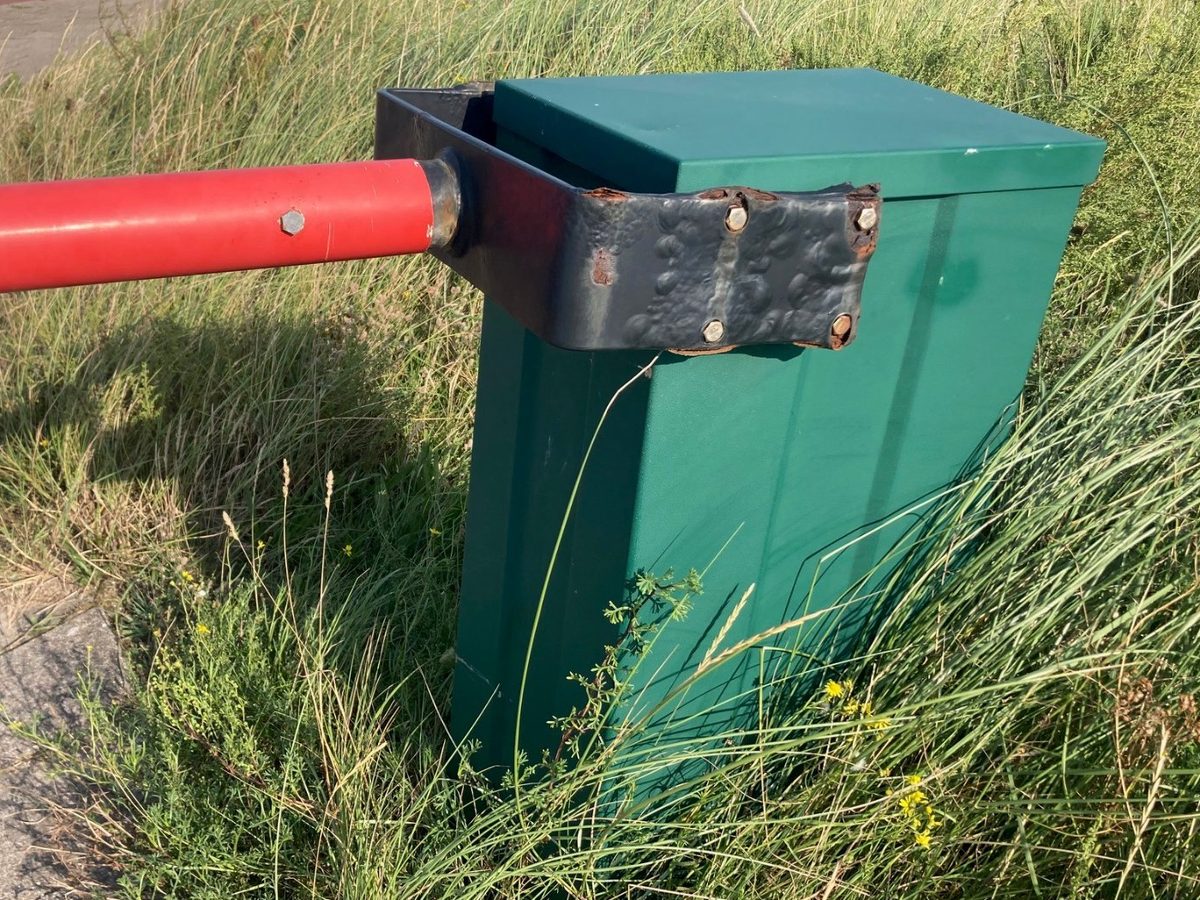
1. Boom and housing (in order)
Observation: the boom itself is in excellent condition, and the same goes for the green housing. You can see that the housing has been touched up locally where damage occurred at some point. In those places the green colour has faded slightly, but certainly not in a disturbing way.
The pretreatment and coating of these components have been carried out excellently.
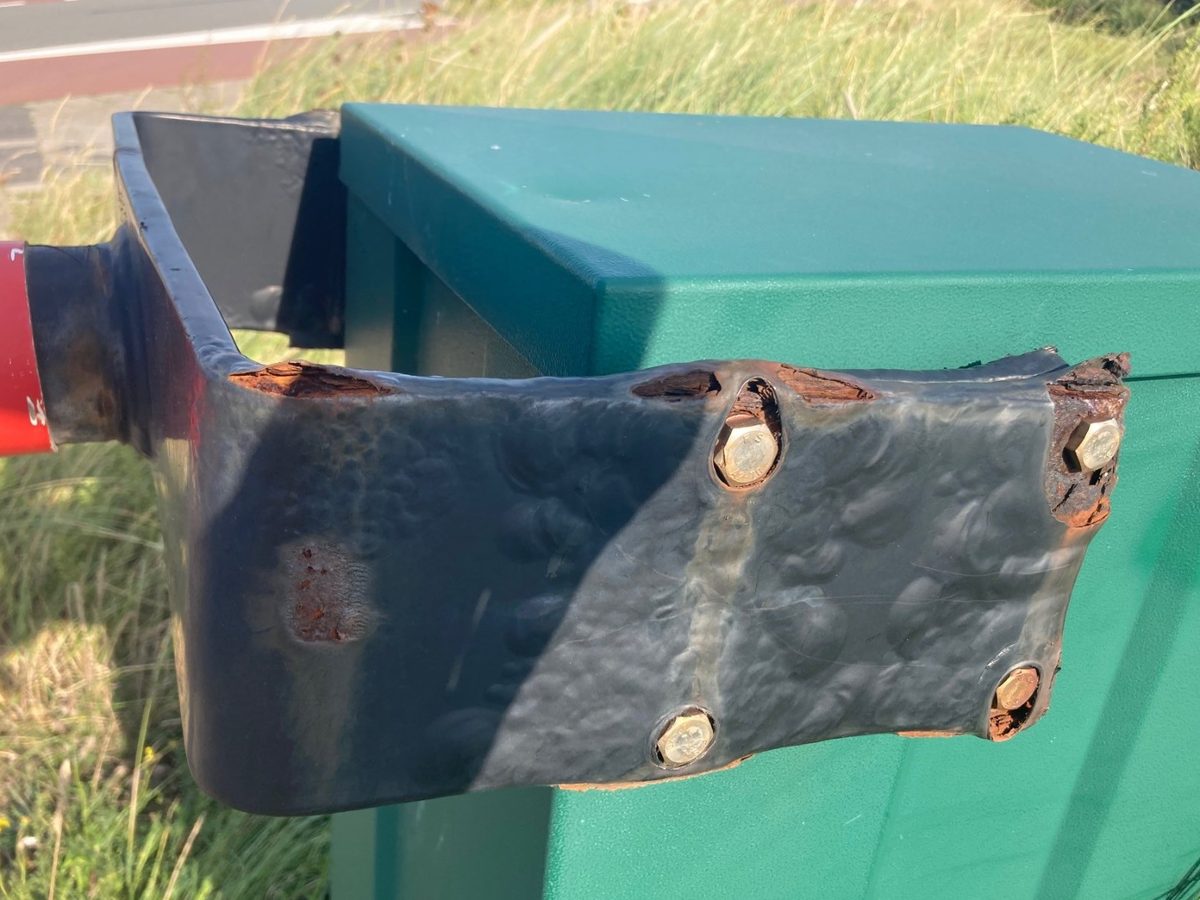
2. Black bracket rusted through completely (defect)
Observation: the black bracket between the boom and the lifting mechanism has rusted through completely. The bolts used are A2 stainless steel and still fully intact.
Consequence: because the steel has been attacked, the bracket could break off. If that happens at the moment a car is driving underneath, the consequences could be serious.
Why is it the bracket that rusts?
Cause: the marine climate obviously plays an important role here. Yet it has had virtually no effect on the housing and the boom. The black bracket is made of non-galvanised steel, whereas galvanising is necessary in this environment and for the expected service life of a product like this. In addition, the bracket is fitted with stainless steel bolts, which can cause galvanic corrosion. The manufacturer of the barrier probably bought in this component and may not have made clear agreements with its supplier about the coating.
Who pays for that?
The bracket needs to be replaced urgently to prevent it from breaking off. In this case the component is not coated well enough for the application, and the supplier should put this right. Depending, of course, on the agreed warranty period.
Discussions like these often only start after years, at the moment coating defects become visible. And they are often difficult, because clear agreements made beforehand are missing.
How could this have been prevented?
With clear agreements beforehand, and a test that confirms them. That comes down to three steps.
- Specify. Set out in a paint specification what the coating has to meet: environment, expected service life, adhesion, corrosion protection and so on. Share that specification with your supplier. For steel in a coastal environment like this one, ISO 12944 provides a basis for specifying the environment and service life.
- Test. Verify your requirements by carrying out the tests listed in the paint specification, such as a corrosion test to ISO 9227. Do this on the product itself, not on test panels. Only then can you see whether the system performs as you expect.
- Verify. Check delivered products regularly, for example by measuring the coating thickness, testing the adhesion and assessing the products visually.
That is how you avoid discussions about quality and cost afterwards.
The art of specifying
What does your purchasing specification say about the coating? Coatings largely determine the service life of a product. Is that as clear to your supplier as it is to you?
We help companies to clarify these expectations, record them professionally and verify that they are met.


